Continuum of Risk
Different nicotine products carry different levels of risk. This page is here to help you understand how they compare — not to judge where you are right now.
Cigarettes carry the highest health risks of all nicotine products.
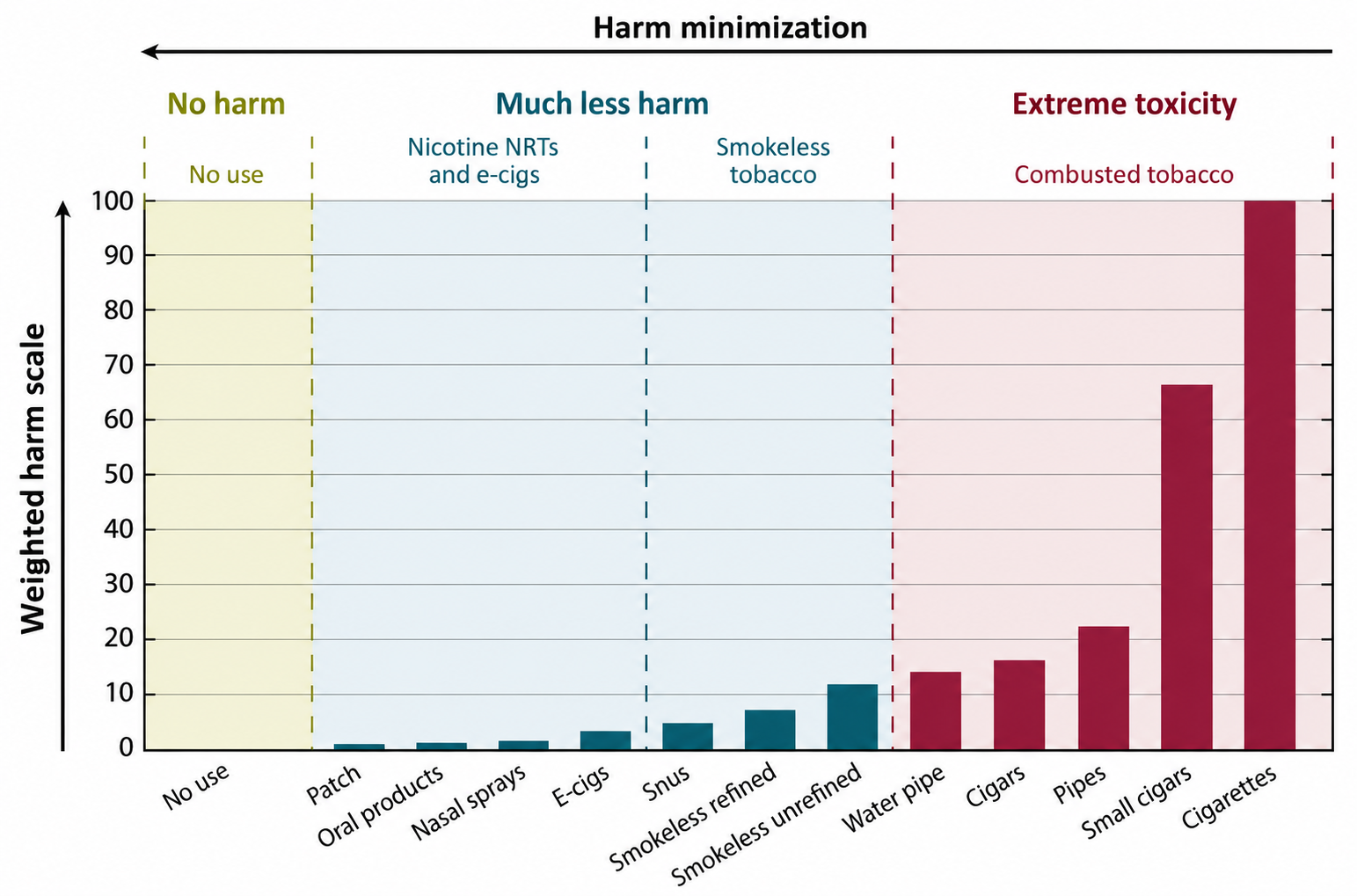
The Nicotine Product Risk Continuum
Adapted from: Abrams DB, et al. Managing nicotine without smoke to save lives now. Evidence for harm minimization. Preventive Medicine. 2018
Before You Move On
If this chart feels like a lot to take in, that’s understandable.
The information below covers nicotine products that can affect your health in very different ways, and many people have never seen them compared this directly before.
When you’re ready, the Navigating Your Path Forward page can help you think through your next step:
As you move from left to right on the above Continuum of Risk chart, the level of harm increases.
The risk in these products comes largely from how nicotine is delivered. Products that burn tobacco create the most harmful chemicals.
The safest option is to use no nicotine at all. But if you use nicotine, the product you choose can make a big difference in risk.
Cigarettes 🚬
Cigarettes sit at the highest-risk end of the chart. Burning tobacco creates thousands of chemicals, including many known to cause cancer, heart disease, and lung disease. That is why cigarettes carry the highest health risks of all nicotine products, but no nicotine product is risk-free. Read what experts are saying.
Heated tobacco products 🔥
Heated tobacco products (HTPs), such as IQOS, are not labeled separately on this chart. They heat tobacco instead of burning it, which may reduce exposure to some harmful chemicals compared with cigarettes. But because these products still contain tobacco, their level of risk may be somewhat higher than electronic cigarettes and SNUS. As with vaping, the long-term effects of HTP are unknown. Some HTP products are authorized for sale in the United States.
Snus 🧫
Snus is a moist, smokeless tobacco product that is placed between the gum and upper lip rather than burned. Because it does not involve combustion, it is generally less harmful than cigarettes. But it still contains tobacco and nicotine, so it is not risk-free. Some Snus products are authorized for sale in the United States.
Electronic cigarettes 🖊️
Electronic cigarettes deliver nicotine without burning tobacco, which is why they are generally considered less harmful than cigarettes. They are not risk-free and can expose users to chemicals, including flavoring chemicals.
E-cigarettes help some adults stop smoking and may be more effective than nicotine-replacement therapies. Because these products are still relatively new, their long-term effects are not yet fully known. Some devices also deliver nicotine very efficiently, which can make them easier to keep using and harder to stop over time.
Some electronic cigarettes are authorized for sale in the United States.
Nicotine pouches ⬜
Nicotine pouches are relatively new oral products that sit between the gum and upper lip. Their main risk is the absorption of large amounts of nicotine, which can contribute to symptoms such as palpitations and reflux. Less is known about their long-term effects because these products are newer. Some Nicotine pouch products are authorized for sale in the United States.
Nicotine gum, patches, and lozenges 💊
Other oral products such as nicotine gum and lozenges, as well as patches, deliver nicotine without burning tobacco. They are among the lower-risk nicotine products and are often used to help people reduce cigarette use or quit entirely. They are approved by the FDA for use in the treatment of tobacco use. Nicotine patches and gum are available over the counter.
Lower risk does not mean risk-free. It means fewer harmful chemicals than cigarettes.
Dual Use
Using cigarettes together with e-cigarettes — sometimes called dual use — does not reduce your health risk the way fully switching does. The biggest health benefits come from fully moving away from cigarettes or quitting nicotine entirely.
Cutting down on cigarettes is only effective when part of a strategy to stop smoking entirely. If people smoke fewer cigarettes but inhale more deeply or smoke each one more intensely, they may not lower their risk very much.
What does this mean for you?
This information can help you think about your next step. You might be asking:
Am I ready to quit, or would another step feel more realistic right now?
See Navigating Your Path ForwardWould switching to a lower-risk product reduce some of the health risk I’m facing now?
See Navigating Your Path ForwardHave I tried to quit before and want a better way to build on that experience?
See If You’ve Tried Quitting BeforeDo I want more concrete help making my next quit attempt stronger?
See How to Strengthen Your Next Quit AttemptAm I trying to understand why nicotine has become so important to me in the first place?
See Understanding Nicotine Use and Self-Medication
You do not have to figure everything out at once. But understanding where products fall on the risk continuum can help you make a clearer decision about your next step.